residential Project
"Malibu Modern" Oceanfront Home
Bar Harbor Oceanfront Home A 6,500-Square-Foot Modern Home on Mount Desert Island
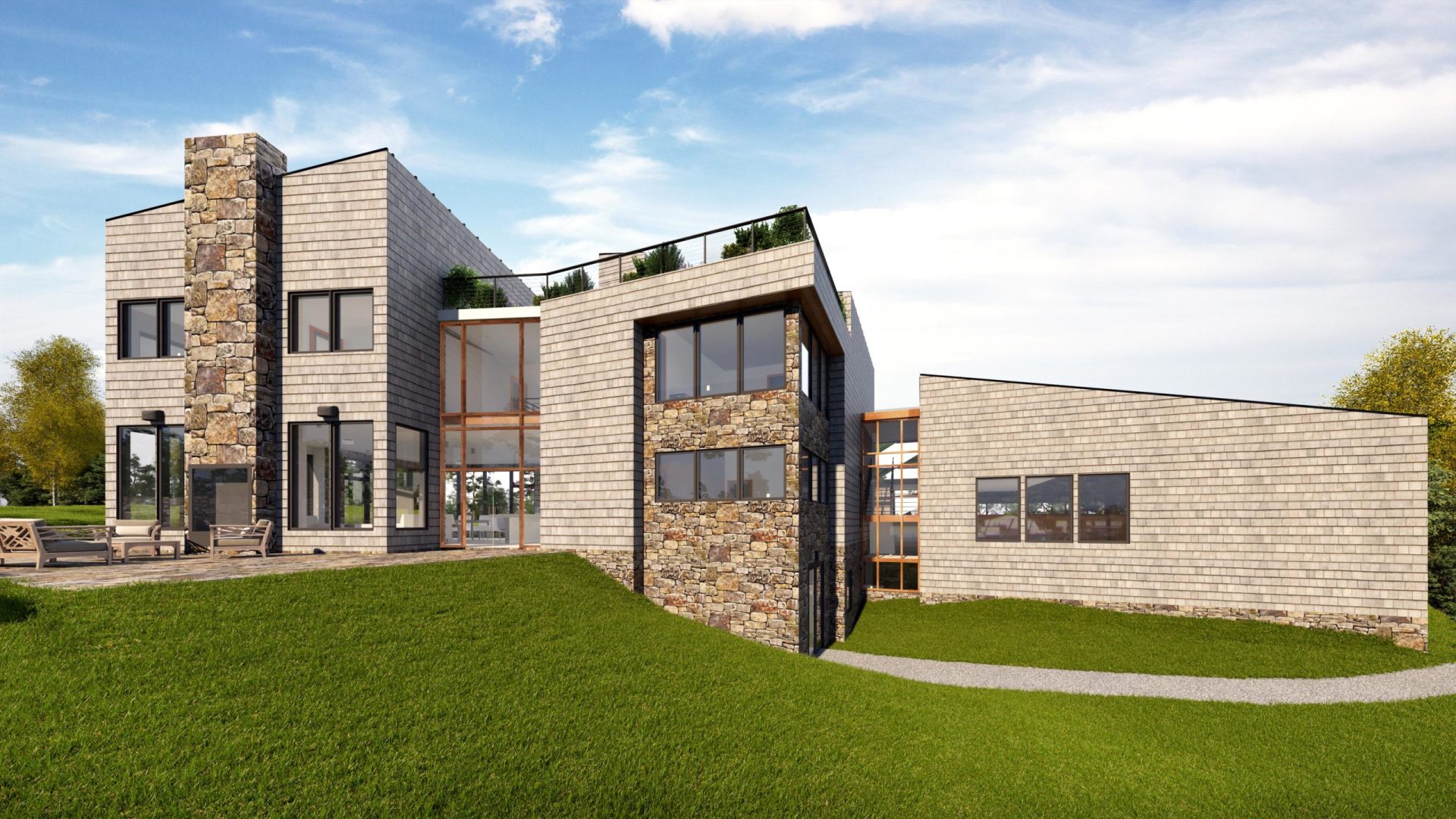
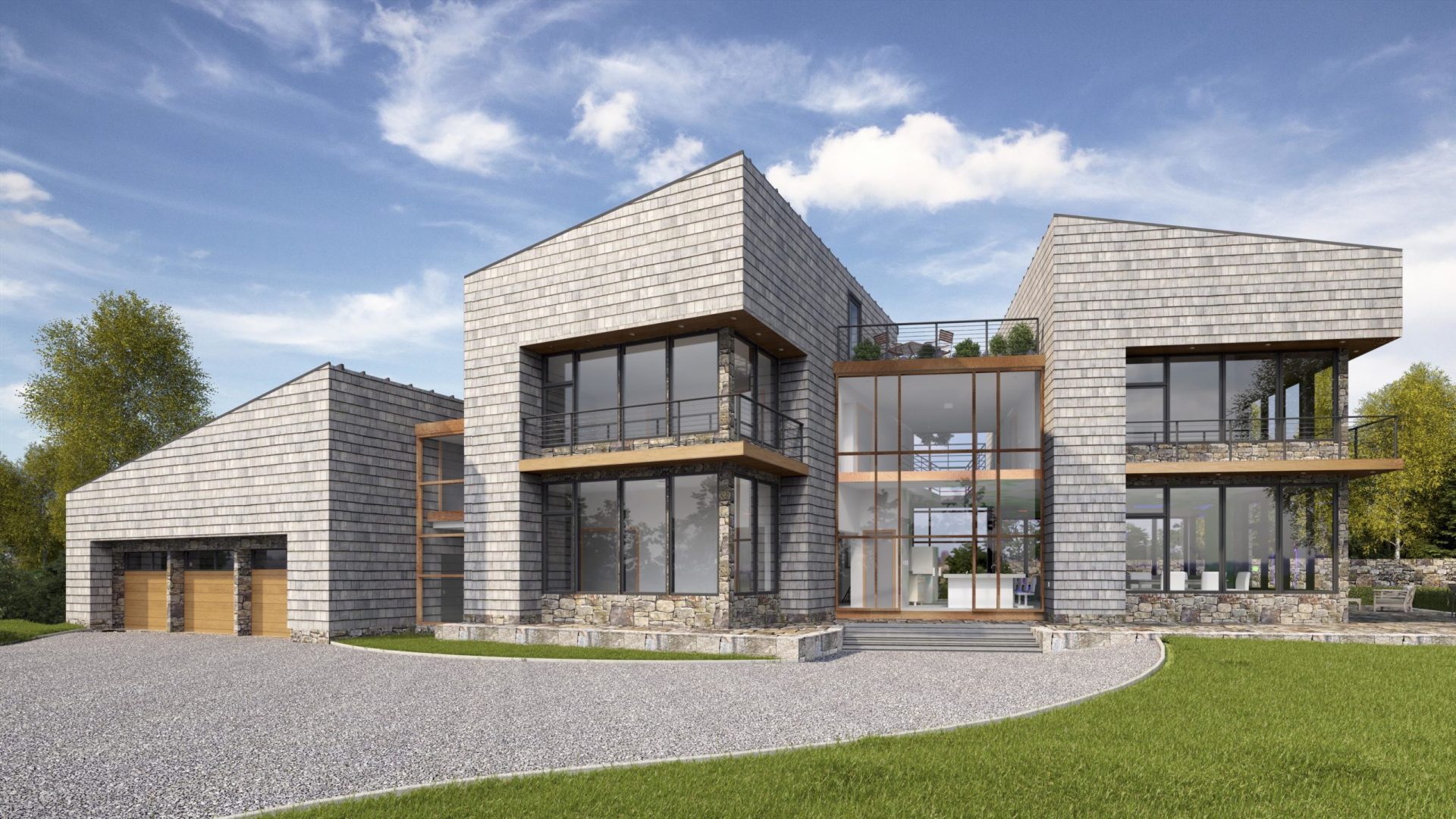
A young couple moving from California wanted Malibu on a hilltop overlooking the ocean in Maine. Six thousand five hundred square feet, tons of glass, facing northwest toward Mount Katahdin. Northwest is where the wind comes from. It is the one direction in Maine you do not fill with glass.
Saying no would have been easy and defensible. Instead the house broke into three volumes — a form taken from the broken stone already on the site — each free to turn on its own. Glass where it earns its heat, high R-value where the wind hits, the garage placed to break the weather across the entry yard. Net zero on thermal mass and an expansive ground-source heat pump system powered by the sun.
Four bedrooms, an open kitchen and living space around a double-flue stone fireplace, a wood shop, a soundproof music studio, a rooftop patio with a vegetable garden and a hot tub. The couple went back to California before ground was broken. The drawings are finished. The house has never been built, and it is still looking for its hill.
Location
Bar Harbor, Maine
STYLE
Contemporary Residential
Services
Residential Design & Engineering
CATEGORY
Residential
PROJECT SIZE
6500 FT² / 604 M²
A story yet to be realized
Bringing Malibu Modern to Maine
A California client falling in love with the idea of the Maine coast but focused on relocating some nostalgia on their roots; a challenge for a harsh 4 season climate that encourages thermal mass and minimal glazing.
Sand beaches were replaced by a rocky coastline. Blistering summer head was replaced by warm breezes. Temperate winters were replaced by icy coastal storms. For this client, the trade-offs were more than just climate. The wanted a simpler, more family-focused lifestyle where they could raise a family and get back to what matters. That story is all-too-common for those out-of-staters looking to relocate and build their home in Maine.
A Design Inspired by the Landscape but Formed by the Climate
There was an asymmetrical pasture of wildflowers and timothy grasses ringed by the rubble of old field stone walls, and a broad seaview that explained immediately why they had bought it.
Views in Maine come with a reckoning. This one faced northwest, straight into the prevailing winter wind — the direction where you keep glass to a minimum and push wall insulation as high as it will go. The client wanted that view in full, through large expanses of glass. Built that way the house would have lost heat continuously and gained almost none, because the solar side would have been at its back.
Three Volumes Instead of One
The answer came from what was already on the site. The stone walls had broken down into scattered rubble, and that decentralization suggested a building made of separate pieces rather than a single mass — three volumes that could each be turned and placed independently to meet the microclimate on their own terms. A monolithic form would have had to be carved away to achieve the same thing, and carving was not the language the client had in mind.
Turning the House Toward the Sun
The client gave ground where it mattered. Glass went south for solar gain. High-R walls went north against the wind. The original favorite view was teased rather than framed, and over the course of the design the client found they preferred what the south gave them. The garage was positioned to break the wind off the dooryard.
From there the building asked for more. Solar panels, thermal mass and ground-source heat pump technology entered the conversation and the house moved toward Net Zero — not a goal set at the outset but the logical end of decisions the site had already forced.
Built for Exposure
This is a design for open ground. Unobstructed wind, no shelter from neighbors or trees, weather arriving off an unbroken horizon, and an owner who wants glass anyway. Those are the conditions on a Maine coastal site, and they are the conditions this house was solved for — envelope first, orientation second, glass placed where it pays rather than where the first sketch wanted it. A house designed to hold its temperature on an exposed site holds it anywhere.
The Program
Four bedrooms. An open kitchen, living and dining zone. A three-car garage and a wood shop. A double-flue stone fireplace. A rooftop patio with a vegetable garden and a hot tub.
And the things that make a house belong to particular people. He wanted a bat cave — not a man cave, a bat cave, with secret passageways and hidden doors, out of a long attachment to Bruce Wayne. She played bass and had worked as a professional chef, so she wanted a soundproof studio and a kitchen built to a chef’s standard.
Unbuilt, and Available
Then the pandemic arrived, the project was shelved, and the client moved away. What remains is a complete set of drawings for a house that was never built, and it is still some of the best work this office has produced. It is waiting for the right site and the right owner to put their own spin on it.