
Rooftop spaces have quietly become some of the most powerful revenue-generating real estate in hospitality and live entertainment. A great rooftop bar or sky deck can turn a “nice venue” into the place everyone wants to be seen.
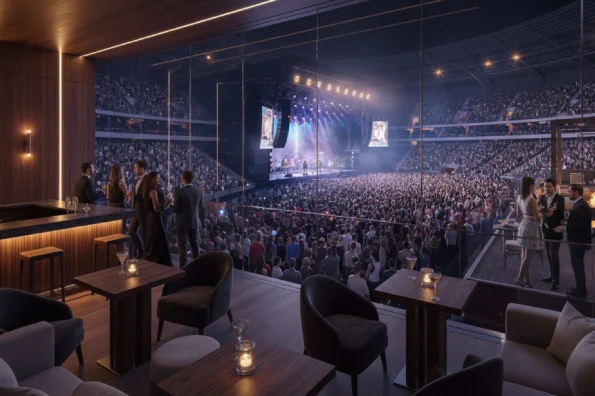
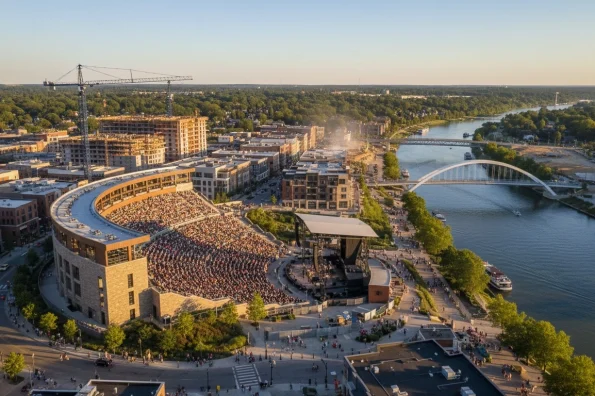
At Ervin Architecture, we’ve seen this firsthand through projects like the KANU rooftop lounge in Old Town, Maine—a three-level adaptive reuse project with a farm-to-table restaurant, nightclub, and rooftop bar—and the Waterfront Concerts Rooftop Premium Seating at Maine Savings Amphitheater. Both projects share a common goal: create elevated spaces that feel unforgettable without feeling exclusive in the wrong way.
1. The rooftop as a “fifth elevation”
Too many projects treat the roof as leftover space. We treat it as a fifth elevation—a highly visible, highly experiential canvas.
That starts with: – Views: What do people see when they first step out of the elevator? A skyline? Riverfront? Historic street? – Edges: How can railings, glazing systems, and parapets frame those views, rather than block them? – Lighting: How will the rooftop read from the street below or across the river at night?
At KANU, the rooftop lounge crowns a historic brick-and-timber building and has been celebrated as a new icon of rooftop design in Old Town. The rooftop isn’t just an afterthought—it’s a signature.
2. Designing for microclimates, not just square footage
Rooftops don’t have one climate; they have many microclimates. Wind speeds shift by zone, sun angles change by season, and temperatures can swing significantly between exposed corners and protected nooks.
Our rooftop design playbook focuses on: – Creating a gradient of experiences: from fully exposed sun decks to covered lounges and semi-enclosed niches. – Positioning bars, furniture clusters, and planters to create wind breaks. – Using flexible glazing or operable wall systems to extend the season and give operators more days of revenue.
These strategies were central to the KANU rooftop bar, where flexible commercial glass systems and carefully planned seating zones allow the space to adapt to Maine’s changing weather while still feeling open-air and connected to the town.
3. Blending luxury with durability
Rooftop spaces take a beating: UV exposure, freeze-thaw cycles, driving rain, potential snow loads. At the same time, guests expect them to feel luxurious.
We spend a lot of time on: – Material selection: high-performance decking, exterior-rated fabrics, durable metals that patina gracefully, not painfully. – Drainage and detailing: subtle slopes, concealed scuppers, and edge conditions that keep guests dry and surfaces safe. – Lowmaintenance design: finishes that clean easily and age well, so operators can focus on service, not constant repair.
The Waterfront Concerts rooftop suites, for example, combine outdoor sofas, dining areas, and high-end finishes in an environment that has to stand up to both harsh weather and the energy of sold-out shows.
4. Social choreography: how people actually use rooftops
A rooftop is successful when it feels effortless to move through. That “effortless” feeling takes a lot of choreography.
We ask: – Where do people naturally gather first? – What are the best spots for social media moments (and how do we make those spots look great from every angle)? – How can servers move quickly and safely even when the space is packed? – Where do introverts and small groups go to escape the buzz without leaving the venue?
By zoning rooftops—bar-centric, lounge-centric, dining-centric, and “perch” zones along the edges—we give operators flexibility to adjust programming across the week: quiet dinners on Wednesdays, DJ nights on Fridays, pre- and post-show hangs on concert dates.
5. Connecting rooftop moments to brand and place
The best rooftops don’t feel generic. They feel like they could only exist here.
At KANU, design elements pay tribute to Old Town Canoe, a historic local company tied to the owner’s family. The rooftop uses textures, materials, and details that nod to the region’s timber and river heritage while still feeling contemporary and cosmopolitan.
At Maine Savings Amphitheater’s rooftop suites, the design leverages views of downtown Bangor and the Penobscot River, turning the city and water into part of the show itself.
When elevated spaces reinforce an authentic story, they stop being “just a bar” and become a place people talk about—and travel for.
If you’re considering a rooftop bar, premium deck, or sky lounge—whether atop a restaurant, hotel, or live music venue—Ervin Architecture can help you turn that overhead space into your most desirable front door.