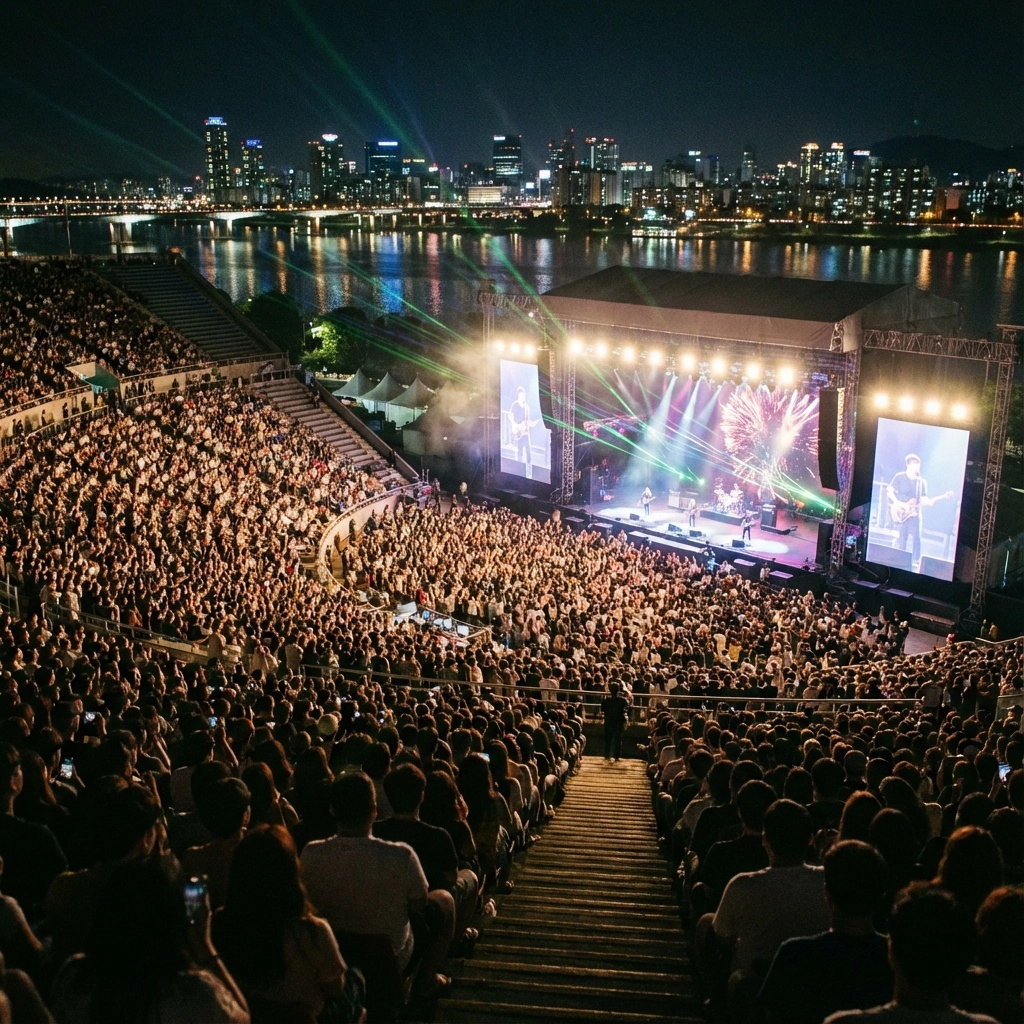
If you ask a fan what they remember about a great concert, it’s almost never the structure. It’s the feeling: the sound cutting clean through the night, the view from their seat, the energy of thousands of people moving as one. The job of an amphitheater architect is to turn those intangible moments into something you can draw, engineer, and build.
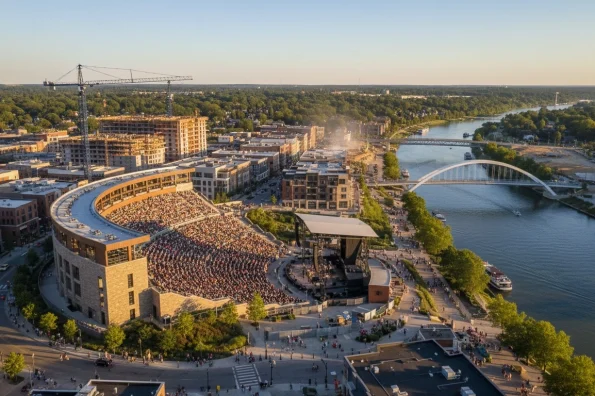
At Ervin Architecture, we’ve lived that process for years at the Maine Savings Amphitheater in Bangor, Maine—an open-air venue on the Penobscot River that now hosts up to roughly 16,500 fans and stands as the largest assembly occupancy facility north of Boston. This project has reshaped how we think about amphitheater design.
1. Start with the land, not the stage
The best venues don’t fight their sites—they amplify them. Maine Savings Amphitheater is literally carved into a a hillside between downtown Bangor and the riverfront. The grade change became an asset, allowing us to stack seating, terraces, and circulation paths in a way that feels natural, not forced.
For new amphitheaters, we start by asking: – How can we use natural topography to improve sightlines? – Where can we tuck in circulation, concessions, and service spaces so the fan experience stays seamless? – How does the venue frame its surroundings—skyline, water, mountains—instead of turning its back on them?
The result should feel like the venue belongs there, not that the land lost a fight with the bulldozer.
2. Design for sound from the very first sketch
Acoustics aren’t a layer you sprinkle on later. In outdoor venues, they’re everything.
At Maine Savings Amphitheater, the seating geometry and stage relationship were tuned to deliver clean sound all the way from the front-of-house pit to the upper lawn, while still respecting Bangor’s noise ordinances and nearby neighborhoods.
Key strategies we use again and again: – Shape seating bowls and roofs to reflect sound toward the audience, not the city beyond. – Protect critical listening zones from wind and environmental noise. – Coordinate acoustic goals with production lighting, rigging, and structural spans so nothing works against anything else.
If the sound fails, the venue will never feel “world-class,” no matter how beautiful the architecture is.
3. Make premium experiences feel integrated, not tacked on
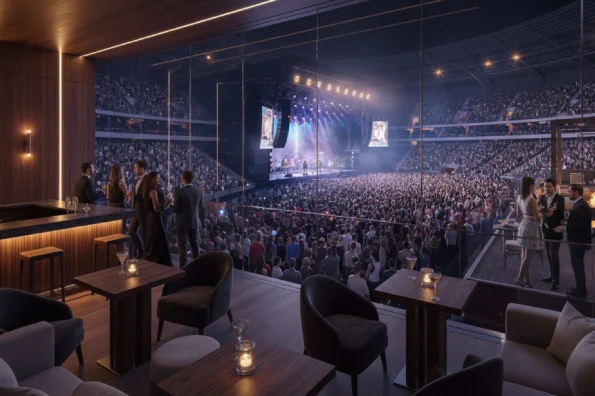
Modern venues live or die based on their premium offerings: suites, clubs, terraces, and rooftop decks. At Maine Savings Amphitheater, we expanded the premium experience with the Waterfront Concerts Rooftop Premium Seating—a series of rooftop suites and social zones overlooking the stage and the Penobscot River.
The design principle is simple: premium zones should feel like the best possible way to be part of the same show—not an entirely separate event.
That means: – Direct visual connection to the stage and crowd – Easy access to concessions, restrooms, and circulation – Materials and lighting that feel elevated, but still in the same “family” as the rest of the venue
Done right, these premium experiences become the financial engine that allows promoters and cities to keep booking bigger acts and investing in the venue year after year.
4. Think like a city, not just a venue
An amphitheater of this scale is effectively a temporary city on show nights. Fans arrive in waves, move between zones, eat, drink, shop, and then all try to leave at once. If any part of that choreography fails, the entire night feels worse than it should.
Our approach focuses on: – Decoupling back-of-house operations from fan circulation – Creating multiple “pressure relief” zones—lawns, plazas, terraces—where crowds can distribute naturally- Designing lighting, signage, and wayfinding to keep the experience intuitive, even for first
time visitors
For Bangor, the venue’s impact goes beyond the gates. A University of Maine study pegged the broader Waterfront Concerts series as a multi-million-dollar economic catalyst for the city. When an amphitheater is planned well, restaurants fill, hotels book up, and surrounding neighborhoods gain momentum.
5. Build in phases, but design as a whole
Maine Savings Amphitheater was developed through multiple construction phases over several years. Without a unified master plan, that kind of phasing can lead to a stitched-together feel. Our team kept one cohesive vision from the first massing sketch to the latest premium upgrades, so each phase felt like a natural evolution, not a patch.
For owners and cities considering a new or expanded venue, this is often the most empowering insight: you don’t need every dollar on day one. You need a master plan that can grow gracefully and still feel like one iconic place.
At Ervin Architecture, amphitheater and music venue design is not just a portfolio category—it’s a core part of who we are. If you’re exploring a new venue or reimagining an existing one, we’d be glad to talk through how these lessons could apply to your city, campus, or waterfront