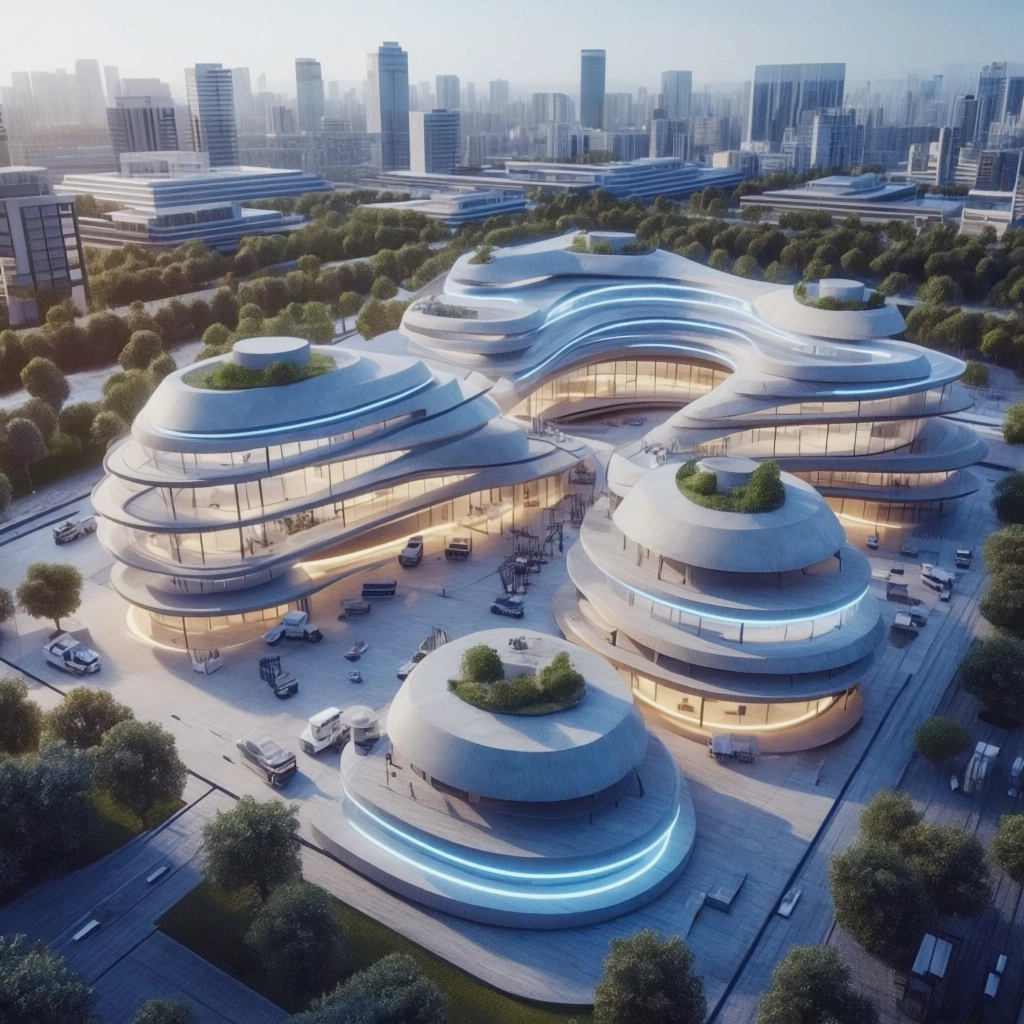
Ervin Architecture is embarking on a 7 blog journey with its readers that will highlight the innovations in the Commercial and Residential Architecture industry and giving our two cents on the topic, the application, and it’s impact on the field on architecture as a whole for our wonderful clients.
1. AI-Augmented & Generative Design: Architecture’s New Creative Partner
In the past decade, digital tools have transformed architectural practice—but nothing has re-shaped the design conversation as rapidly as artificial intelligence. At Ervin Architecture, we see AI not as a replacement for human creativity, but as a creative partner, unlocking new ways to think, iterate, and refine.
AI-driven generative tools allow architects to explore thousands of design options in seconds. Want to study how daylighting shifts across a massing strategy? Or test how a façade might perform under different climate scenarios? Generative software can simulate these conditions instantly, helping us make more informed decisions earlier in the design process.
Perhaps the most transformative shift is the ability to generate context-aware design options: massing that responds to urban fabric, floorplans optimized for circulation, or structural systems tailored to performance criteria. Architects remain the curators of these possibilities, guiding the aesthetic, functional, and cultural elements that define meaningful architecture.
As AI continues to evolve, we’re only beginning to understand its potential. What will it mean for custom fabrication, energy analysis, or even community engagement? At Ervin Architecture, we’re embracing AI not for novelty, but because it helps us design buildings that are smarter, more efficient, and more responsive to the people who use them.
2. Regenerative Design & Living Materials: Beyond Sustainability
Sustainability is no longer enough.
Today’s climate challenges demand that buildings do more than reduce harm—they must actively contribute to the health of their ecosystems. This emerging movement, often called regenerative design, pushes architecture toward a future where built environments and natural environments work in harmony.
Regenerative design asks new questions:
- Can a building repair damaged landscapes?
- Can materials store carbon rather than emit it?
- Can architecture participate in ecological cycles instead of interrupting them?
Living materials—such as mycelium composites, algae façades, or bio-engineered surfaces—are part of this story. These materials can grow, heal, sequester carbon, or regulate interior conditions. While still emerging, they point toward a future where buildings behave less like machines and more like organisms.
At Ervin Architecture, regenerative thinking influences how we approach site design, material selection, and long-term building performance. We evaluate not just energy usage, but life-cycle impacts, ecological value, and the potential for buildings to be catalysts for environmental renewal.
Regenerative design reframes architecture as an active contributor—not simply a consumer—in the planet’s future.
3. Smart Buildings & Digital Twins: The Rise of Responsive Architecture
As technology moves into every facet of modern life, architecture is becoming increasingly intelligent. Smart buildings integrate sensors, automation, and real-time analytics to create spaces that can respond dynamically to the needs of occupants.
Imagine a building that adjusts its lighting based on circadian rhythms, recalibrates ventilation when occupancy patterns shift, or uses predictive maintenance to extend the life of mechanical systems. These features are no longer theoretical—they are rapidly becoming industry standard.
Digital twins take this concept further. A digital twin is a living, virtual replica of a building that receives continuous data from the physical structure. This creates powerful opportunities for simulation, forecasting, and optimization throughout the building’s lifespan.
For architects, this technology inspires new ways of thinking. Buildings don’t end at the ribbon-cutting—they evolve. Smart infrastructure allows our designs to adapt to future changes in occupancy, energy supply, or climate conditions.
At Ervin Architecture, we view smart design as a way to enhance performance and occupant well-being, while also reducing long-term operational costs. The future of architecture is responsive, data-driven, and deeply attuned to the people who inhabit it.
4. Modular Construction, 3D Printing & Advanced Fabrication
A quiet revolution is reshaping how buildings are made. Advances in modular construction, prefabrication, and robotics are enabling faster, cleaner, and more precise construction methods than traditional on-site building.
Modular and prefabricated systems reduce construction timelines, improve cost predictability, and decrease waste. Controlled fabrication environments produce higher-quality assemblies, while allowing architects finer control over tolerances and material performance. This approach is particularly valuable for housing, hospitality, and high-performance building envelopes.
3D printing pushes fabrication even further. Whether printing façade components, structural elements, or even entire building shells, 3D printing allows us to create forms and geometries that would be difficult—or impossible—to build using traditional methods.
But the impact isn’t just aesthetic. Advanced fabrication reduces site disturbance, limits resource use, and improves worker safety. For Ervin Architecture, these methods open new creative possibilities while supporting our commitments to efficiency and environmental responsibility.
The future building site may look less like a construction zone and more like an assembly platform—and that shift has enormous implications for speed, quality, and sustainability.
5. Biophilic & Human-Centered Design: Architecture That Improves Well-Being
For decades, the design industry focused primarily on form and function. Today, a new priority has emerged: well-being.
Biophilic design integrates forms, materials, and environmental qualities that connect people with nature. Research shows that views of greenery, natural materials, fresh air, and access to daylight can significantly enhance mood, productivity, and health.
Meanwhile, inclusive design ensures that spaces work for people of all abilities, ages, and backgrounds. Accessibility is no longer seen as an add-on or code requirement—it is central to creating dignified, equitable environments.
At Ervin Architecture, our design approach emphasizes comfort, clarity, and delight. We think about how a space feels, how it supports the flow of daily life, and how it can uplift its users. By integrating natural elements, sensory comfort, intuitive wayfinding, and inclusive planning, we create architecture that serves everyone.
Human-centered design is not a trend—it’s the foundation of spaces that truly work.
6. Urban Resilience, Climate Adaptation & Low-Carbon Strategies
Climate change is reshaping cities across the globe—through rising temperatures, increased flooding, energy uncertainty, and ecological fragility. As a result, the most forward-thinking architecture today centers on resilience and low-carbon strategies.
Resilient design asks how buildings can withstand new environmental stresses. This includes flood-resistant site planning, adaptive façades, passive cooling strategies, and robust envelope performance. These measures not only enhance safety, but often improve comfort and energy efficiency as well.
At the same time, the shift toward low-carbon design—particularly mass timber construction, low-embodied-carbon materials, and high-performance envelopes—is one of the most important industry transformations in decades.
For Ervin Architecture, resilience is both a responsibility and an opportunity:
- A responsibility to protect communities and ecosystems.
- An opportunity to innovate through material science, passive design tools, and new construction strategies.
Our goal is to design buildings that thrive in the climate of today and tomorrow.
7. Parametric & Computational Design: Expanding Architectural Possibility
As computational tools become more advanced, architects can now explore forms and behaviors with a level of precision and complexity previously unimaginable. Parametric design uses algorithms to establish relationships between design elements, making buildings more adaptive, performative, and expressive.
Want a façade that responds to solar exposure? Or a structural grid tailored to material efficiency? Parametric modeling allows us to study countless permutations quickly, selecting the solutions that best balance aesthetics, performance, and cost.
This approach also improves collaboration between architects, engineers, and fabricators, since parametric models can integrate structure, climate data, and fabrication constraints into a single dynamic system.
At Ervin Architecture, computational design is not about producing radical shapes—it’s about producing smarter architecture. Whether optimizing daylight, tuning acoustics, or refining structural behavior, parametric tools expand our ability to craft environments that are both visually compelling and deeply grounded in performance.